Years of PPC experience
Across Google, Microsoft and paid social


Connect high-intent search, shopping, audience media, creative, landing pages and measurement through one accountable operating model.
These owner-confirmed figures describe selected RankSpell experience and managed-account outcomes; they are not forecasts or guarantees for a new engagement.
Across Google, Microsoft and paid social
Across selected RankSpell-managed accounts
Selected post-audit result within 60 days
Across multiple industries and markets
RankSpell plans paid media around customer value, budget reality and the decisions the business can support—not raw traffic volume.
Before increasing spend, RankSpell checks whether the inputs can support useful learning and responsible growth.
The account can optimise toward a qualified lead, purchase, revenue value or another action that genuinely matters.
Consent choices, tags, CRM stages and platform diagnostics are strong enough to support decisions—with limitations documented.
The proposition, proof, landing experience and follow-up process can convert the demand the campaign earns.
Sales, service or fulfilment teams can act on additional demand without sacrificing response quality or customer experience.
The programme has useful assets, decision ownership and sufficient budget to test a meaningful question.
Paid media can introduce a credible alternative, capture existing intent, support evaluation and reconnect eligible customers. Each stage needs a distinct role and measure.
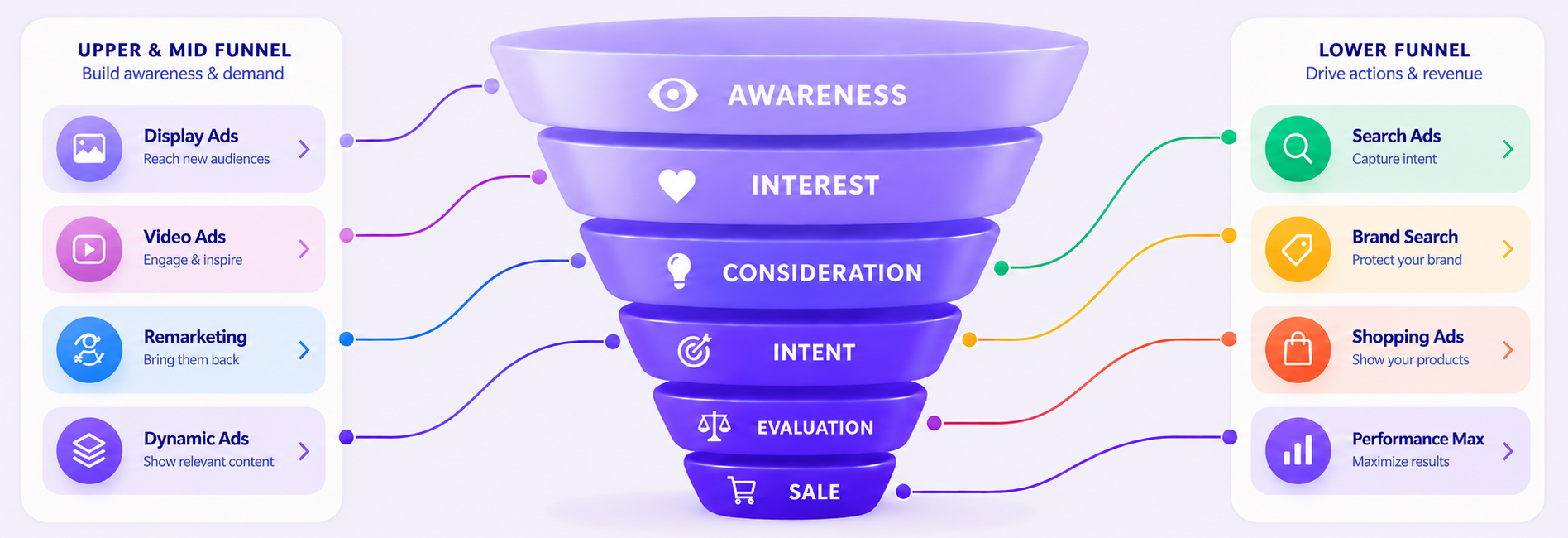
They fail when media, measurement, message and destination are optimised as separate systems.
Campaigns are optimised around clicks or shallow actions without a reliable connection to lead quality, sales or customer value.
Impressions and click-through rates look active while cost per qualified outcome and marginal return remain unclear.
Broad reach and automated bidding amplify incomplete goals, poor values, thin creative or irrelevant landing destinations.
The advert earns attention, but message mismatch, slow pages or a difficult next step prevent useful action.
Choose the right campaign type for the job, then connect it to strong inputs and a destination capable of converting demand.

Capture valuable demand through query governance, useful ads and appropriate landing pages. AI Max can expand matching and asset optimisation, but it remains a configurable layer—not a substitute for goals, controls and review.
Use conversion values, first-party audience signals, feeds, creative assets, exclusions and the channel performance report to understand where the campaign is serving and why.
Connect clean product data, commercial priorities, inventory reality, bidding and landing destinations to profitable ecommerce demand.
Reconnect eligible audiences through appropriate recency, exclusions, consent and message sequencing instead of repetitive exposure.
Use video and image-led campaigns across Google’s visual surfaces when the objective, creative system and measurement are ready.
Improve message match, accessibility, Core Web Vitals, form experience and decision support around the campaign’s real intent.
Configure relevant platform conversions, GA4 key events, Microsoft UET, Meta Pixel and Conversions API or enhanced conversions where appropriate. Use consented first-party data and offline outcomes only when policy, permissions and system quality support them.
RankSpell selects platforms and campaign types according to audience behavior, demand, creative readiness, policy eligibility and measurement—not because every client should use every channel.

Review economics, demand, account history, measurement, creative, landing paths and operating constraints.

Define goals, values, channel roles, budgets, audiences, controls and the first useful learning questions.

Build campaigns, assets, feeds and destinations; verify consent behavior and conversion diagnostics before release.

Read search terms, channel diagnostics, creative signals and downstream outcomes without overreacting to noise.

Increase investment, coverage or creative only when capacity, economics and evidence support the next step.
The sequence adapts to access, risk and campaign history. It defines useful deliverables and decisions without promising a fixed performance date.
Plan the first PPC cycleConfirm ownership, billing, account history, policies, economics, capacity and the decisions reporting must support.
Validate consent behavior, conversions, CRM outcomes, feeds, landing paths and known attribution gaps.
Protect useful history while improving campaign structure, controls, creative coverage and destination alignment.
Review early diagnostics, query and channel signals, budget pacing and downstream quality; document what changes next.


The advert, offer, destination and follow-up process form one conversion path. RankSpell reviews the whole path before blaming the bidding system.
Prioritise real visitor experience, including LCP, INP and CLS, without treating a lab score as the business outcome.
Carry the advert’s promise, intent and proof into the page and make the next action easy to understand.
Connect enquiries, qualified stages, purchases or revenue back to the media when systems and consent permit.
Test material questions with a defined hypothesis, decision rule and enough data—not endless cosmetic variation.
Separate observed, attributed and modeled results and document known gaps instead of claiming perfect visibility.
Industry knowledge matters, but eligibility, market economics, business capacity and account evidence determine the actual approach.

Feeds, Shopping, Performance Max and profitable product demand

Policy-aware acquisition for eligible clinics and services

High-intent enquiries with careful qualification

Commercial and residential opportunity generation

Trials, demos, pipeline and longer buying journeys

Compliant acquisition with qualified outcome signals

Demand capture connected to pipeline quality

Local demand, calls, forms and service-area relevance

Credibility-led search and audience acquisition
The account is structured around valuable outcomes, capacity and economics—not whatever a platform is promoting.
Budget pacing, changes, tests, limitations and recommendations are explained in plain language.
RankSpell works through appropriate access while the client retains ownership, billing visibility and continuity.
Campaign performance is not separated from the offer, page experience or follow-up process.
AI-powered features are steered through goals, values, exclusions, first-party signals, creative and human review.

Campaign reporting should show what changed, what the platforms observed or modeled, what happened downstream and which decision is recommended next.
Budget, learning, measurement and account ownership deserve explicit expectations before launch.
Account defects and measurement gaps can often be identified immediately, but reliable performance learning depends on conversion volume, sales cycle, campaign type, budget, competition and the size of each change. Major automated-campaign changes may require a learning period. RankSpell sets review points rather than guaranteeing a fixed result date.
The appropriate mix may include Google Ads, Microsoft Advertising, Meta, LinkedIn or Amazon Ads. We recommend platforms only where audience behavior, creative readiness, economics, policy eligibility and measurement support a credible role.
Yes. RankSpell can configure and validate platform tags, GA4, Google Tag Manager, Microsoft UET, appropriate enhanced-conversion or server-side connections and offline outcomes. Consent choices, browser restrictions, cross-device behavior and platform modeling mean no implementation provides perfect visibility.
Yes. We begin with an access, history, settings, tracking, policy, query, feed, creative and landing-path review. Useful history is retained; the account is not rebuilt merely to make it look different.
Reporting covers spend, pacing, valuable conversions, lead or sale quality where available, experiments, risks and the decisions recommended next. Platform attribution is presented with its limitations rather than treated as causal proof.
There is no useful universal minimum. A workable budget depends on available demand, expected click costs, conversion rate, customer economics, sales capacity and the amount of data needed to make a decision. RankSpell models those assumptions before recommending scope.