Marketing feels disconnected
SEO, paid media, email, social and content are busy, but they are not working from the same commercial priority.


Connect audience evidence, positioning, channels, investment, customer journeys and measurement around the business outcomes that matter.
RankSpell replaces disconnected activity with a practical roadmap your team can understand, execute and improve.
Marketing becomes expensive when every team optimises its own dashboard. Search chases visits, media chases conversions, social chases reach and the website tries to satisfy everyone.
A useful strategy gives each channel a defined role in a real customer decision, makes trade-offs visible and connects learning back to the next investment choice.
Sometimes it needs a clearer way to use what it already has.
SEO, paid media, email, social and content are busy, but they are not working from the same commercial priority.
Channel reports show activity while revenue contribution, lead quality and the next budget decision remain unclear.
The business wants more qualified demand or sales but lacks a sequenced path from today’s constraints to that outcome.
Campaigns, ideas and stakeholder requests consume limited budget and capacity without an explicit trade-off model.
The journey, offer, evidence or follow-up process is losing people after discovery.
Expansion is being planned before demand, category language, competitors and operational readiness are understood.
Past tactics are producing weaker marginal returns and the team needs a better hypothesis—not simply more volume.
Dashboards describe channels but do not explain which decision should change, who owns it or when it will be reviewed.
It is the discipline of choosing who the business can serve, why it should be chosen and how limited attention, money and capability will be used to create measurable customer and commercial value.
Clarify who the business can help, the situations that create demand and the evidence people need before choosing.
Define a useful market position and translate business objectives into measurable marketing outcomes.
Give search, media, content, email, sales and experience distinct jobs across a non-linear decision journey.
Specify key events, commercial outcomes, guardrails and the review rhythm that changes the plan.
RankSpell does not turn every idea into a recommendation. Opportunities are compared through a consistent decision lens, then placed into a sequence the team can realistically operate.
What valuable customer or business outcome could this opportunity change?
Does it remove meaningful uncertainty or friction for the people the business wants to serve?
How strongly do customer, market, performance and operational signals support the diagnosis?
What time, skills, approvals, technology and production capacity are required?
Which foundations, teams or decisions must be ready before this work can succeed?
What could be harmed, how quickly can the decision be tested and can it be reversed safely?
The strategy makes sequencing, obstacles and the evidence required for each next decision visible.
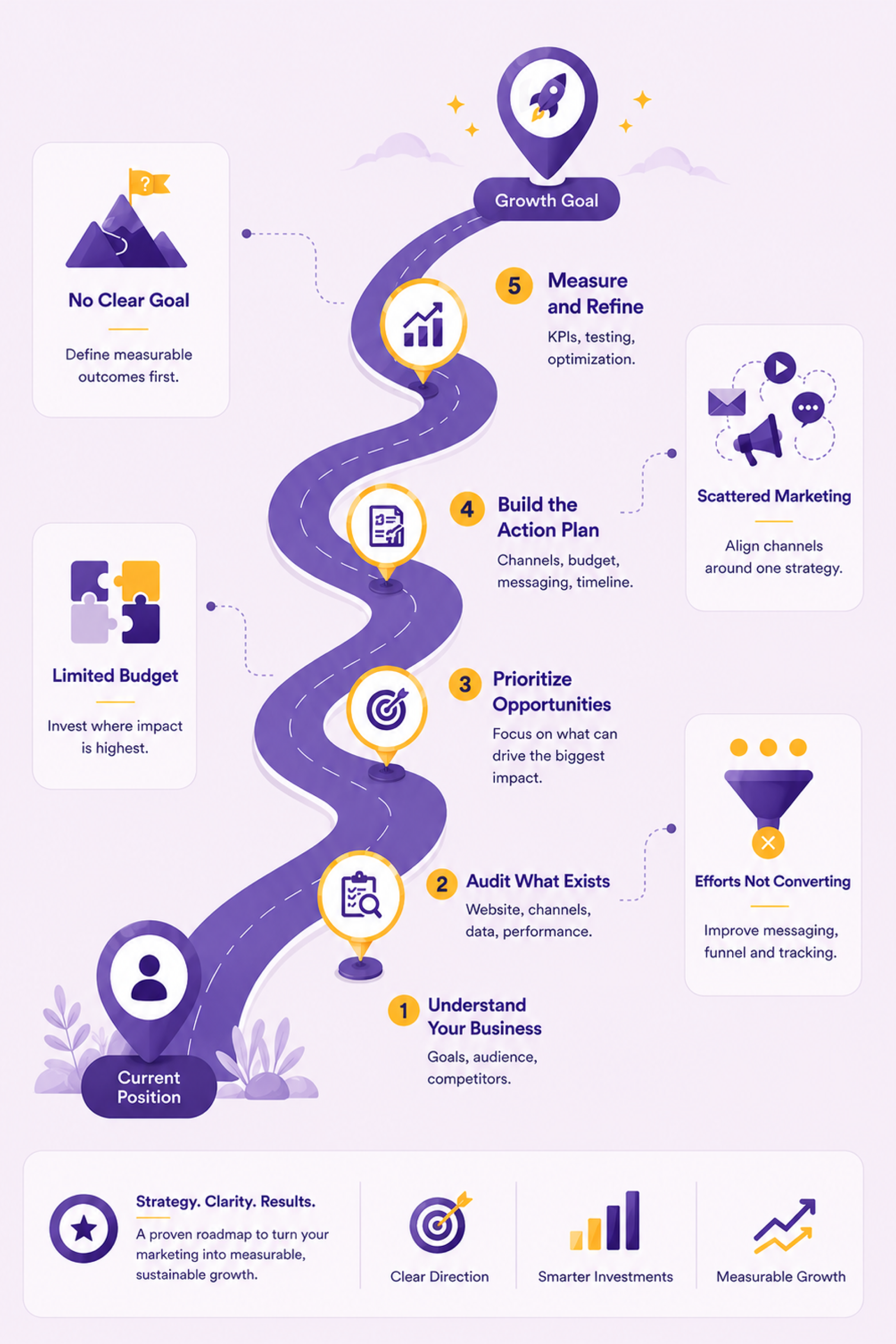
No generic template can choose sensible priorities without understanding resources, systems and the stage of the business.
Priorities reflect affordable spend, expected economics and the cost of learning—not a theoretical maximum.
The plan accounts for who will research, approve, create, implement, sell and report.
Current platforms, data quality, consent, integrations and operational limits shape the recommended route.
A new offer, an established brand and a multi-market company require different sequencing and risk controls.
Align on commercial goals, customer value, operating constraints, current activity and the decisions the strategy must support.
Connect customer interviews, sales insight, demand signals, competitors and category behavior into a usable evidence base.
Define outcomes, leading indicators, key events, guardrails and the known limitations of the available data.
Clarify the promise, evidence, objections and language that should stay coherent across the journey.
Assign each channel a purpose based on audience behavior, economics, capability and measurement readiness.
Sequence themes, offers, landing experiences and production around the decisions customers need to make.
Document owners, approvals, dependencies, handoffs, implementation standards and the first test portfolio.
Use observed and attributed evidence carefully, record learning and change the roadmap when assumptions no longer hold.
Your team receives working documents tied to owners, decisions and the next operating cycle.
The evidence, choices, exclusions and assumptions behind the recommended direction—written for implementation.
Channel roles, budget ranges, dependencies and decision rules connected to business economics.
A sequenced view of priority work, customer moments, production needs and accountable owners.
Triggers, questions, evidence, friction and useful next steps across discovery, evaluation, conversion and retention.
Business outcomes, platform conversions, analytics key events, data owners, caveats and review cadence.
A working session that resolves open choices, aligns the team and makes the next 90 days executable.
The sequence below is a planning framework—not a timeline or results guarantee. Research findings, access, team capacity and implementation dependencies determine the real plan.
Qualified activation frameworkConfirm owners, baselines, measurement definitions and the foundations required for the first priority set.
Put the highest-confidence initiatives into market through controlled releases with explicit guardrails.
Review observed and attributed evidence, resolve implementation constraints and select the next operating cycle.

RankSpell reports from the same operating evidence used to make decisions. Performance is reviewed with its timeframe, scope and relevant commercial context—not reduced to a decorative percentage.
RankSpell strategy-led engagement results supplied by the owner
A good measurement model shows the difference between attention, a meaningful action, an advertising conversion and a realised business outcome.
Connect marketing decisions to qualified demand, sales progress and customer value—not platform volume alone.
Interpret spend against lead quality, conversion, payback and the capacity to serve new customers.
Plan useful onboarding, education, service and re-engagement beyond first purchase.
Build a recognizable promise supported by consistent evidence across customer touchpoints.
Give sales teams relevant messages, proof and feedback loops instead of disconnected campaign assets.
Test new audiences, offers or geographies through staged evidence and explicit risk limits.
Scope, evidence and implementation capacity shape every engagement. These answers establish the operating boundaries.
It is the process of deciding which customers, problems and outcomes deserve focus, then connecting positioning, journeys, channels, investment, execution and measurement into one adaptable operating plan.
Many focused engagements can be completed in three to six weeks, but timing depends on research access, stakeholder availability, market complexity, data quality and the number of decisions that need alignment. We confirm scope and dependencies before promising a schedule.
Yes. RankSpell can implement work within its service scope, collaborate with internal teams and specialists, or provide a documented handoff. Ownership, approvals, account access and reporting responsibilities are agreed before execution.
A template supplies headings. A useful strategy explains the evidence, choices, exclusions, trade-offs and conditions that shape a specific business. It also defines how the plan will change when results or market conditions challenge its assumptions.
We distinguish business outcomes, analytics key events and advertising conversions, then document attribution limits. Multi-touch reports can support decisions, but they do not prove that every credited interaction caused the outcome.